
To recover lost AI visibility, confirm the drop on your Overview, trace it to a single topic in that topic's Visibility report, then open the Explorer to find the cited sources where your brand is missing. This playbook ends with a concrete shortlist of content gaps to act on; it does not write or publish the content for you.
Step 1: Confirm the drop on your Overview
Start on the domain Overview to verify the loss is real before you spend time hunting for a cause. Your goal here is to read the GetMint Score and the headline visibility numbers, so you know how severe the situation is and whether one topic stands out.
The screenshot below shows the Overview dashboard. Look at the GetMint Score, the Average Visibility and Brand Alignment cards, and the Visibility Industry Ranking that lists you against competitors.
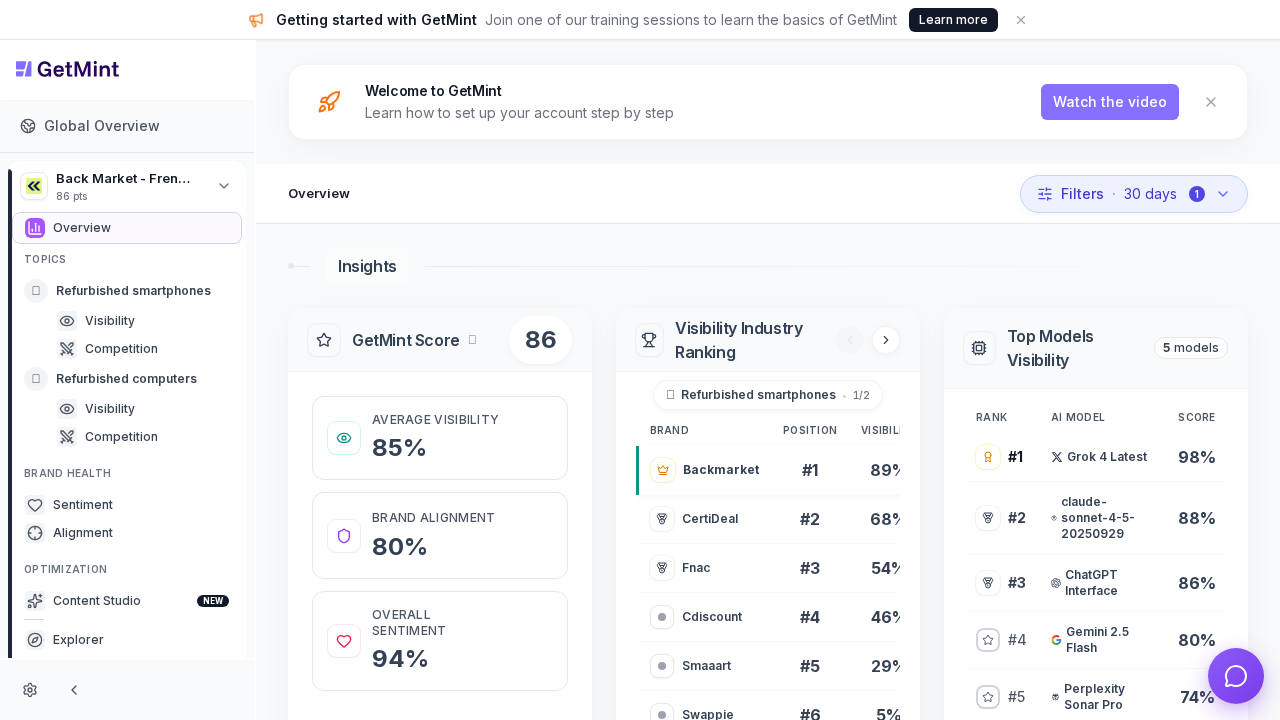
The Overview, with the GetMint Score at 86 and Backmarket ranked #1 at 89% visibility for Refurbished smartphones.
Read the score and the topic ranking together. If your overall numbers held but one topic looks weak, that topic is where the loss is hiding. Note which topic you want to inspect, then move into its Visibility report to localize the change.
💡 Tip: The Content Gap section on the Overview already ranks the highest-priority prompts across topics. Use it as a preview of where to dig in Step 3.
Step 2: Localize the drop in the topic's Visibility report
Open the Visibility report for the affected topic to pinpoint when the loss happened and who you are competing against. The goal is to date the change and read your position against the other brands.
The screenshot below shows the topic's Visibility report. Read Your Visibility Score and the competitor ranking on the left, then follow the Visibility Score Evolution lines on the right.
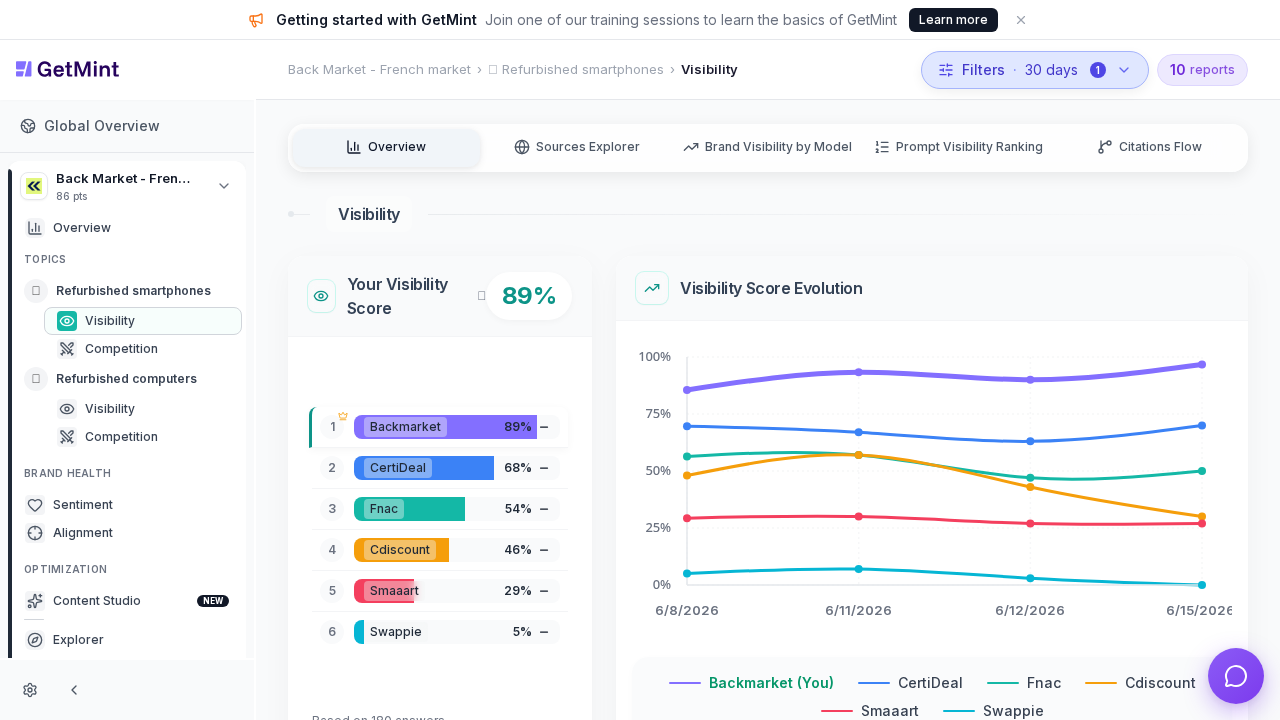
The Refurbished smartphones Visibility report, showing an 89% score and the Score Evolution lines for you and five competitors over time.
Two views tell the story. The Score Evolution chart plots your line alongside CertiDeal, Fnac, Cdiscount, Smaaart, and Swappie over the selected period, so you can date when the lines diverged. The Share of Voice breakdown below it ranks the brands by mention count, so you know who else holds presence in this topic's AI answers.
📌 Note: This report also lists the Top Cited Domains for the topic. Those domains are exactly what you filter on in the next step.
Step 3: Find the content gaps in the Explorer
Open the Explorer to see the individual sources AI assistants cite for the prompts in this topic. The goal is to identify the domains that drive answers — pages on those domains that omit your brand are the gaps to close first.
The screenshot below shows the Explorer with every citation listed. Read the summary counts at the top, then scan the table by Source, Model, Prompt Category, Topic, and Prompt Detail.
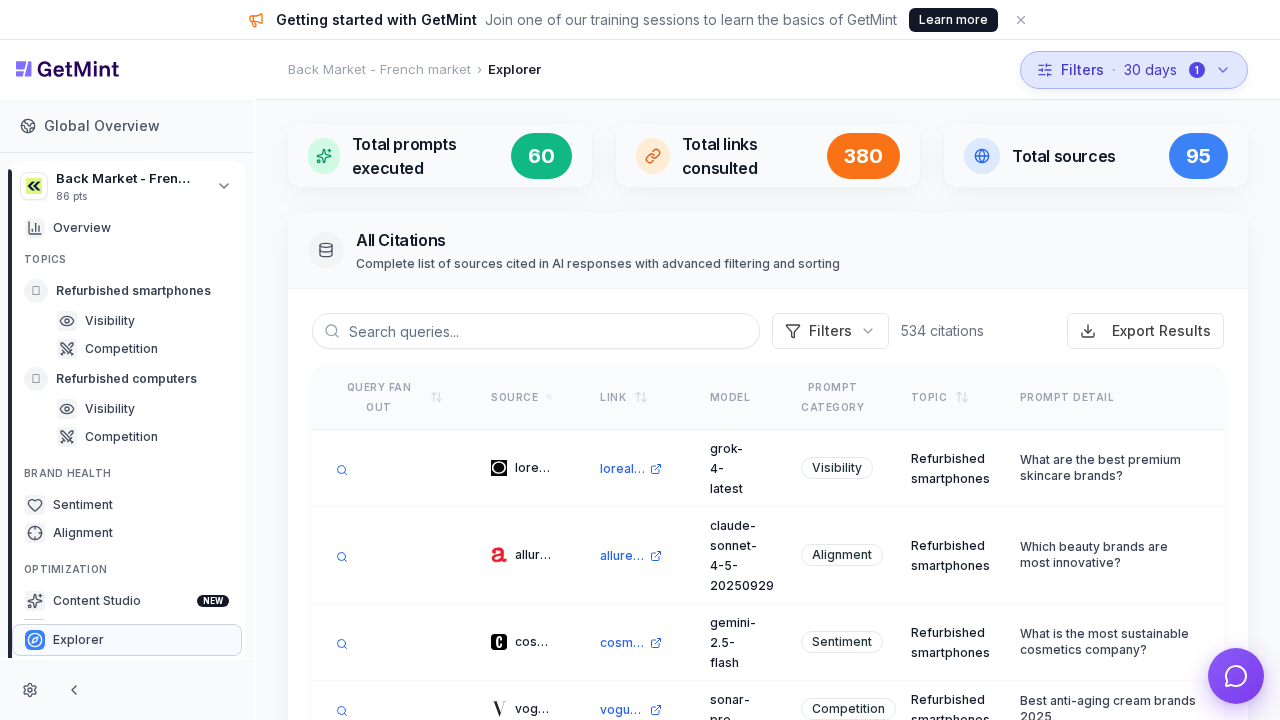
The Explorer, showing 60 prompts executed, 380 links consulted, 95 total sources, and 534 citations in a filterable table.
Each row pairs a cited Source and Link with the Model, Prompt Category, Topic, and the Prompt Detail that produced it — for example, sources like loreal.com, allure.com, and reddit.com against specific prompts. Use the search field and Filters to narrow the table to your priority prompts, then look for the domains that recur. Where a frequently cited source covers your category but does not mention you, that is a content gap; Export Results to hand your team a working shortlist.
⚠️ Beta: Writing and publishing the new content stays on your side. GetMint shows you where the gaps are; you fill them on your own platform.
Step 4: Identify which model caused the drop
A drop rarely comes from "AI" as a whole — usually one engine moved. Inside the topic's Visibility report and the Explorer, filter by model (ChatGPT, Perplexity, Gemini, Google AI Overview) and read each line on its own.
- Drop on one model only — the source mix for that engine changed. Open the Explorer filtered to the affected model and look at the third-party domains that now dominate. Your gap-list belongs to that engine.
- Drop across every model — broader cause: stale content, a question that shifted, or a competitor that genuinely gained authority everywhere.
- Drop on a live-web-search model but not the others — fresh-content signal. New pages on the topic exist that don't include you yet.
Acting on the right engine is the difference between a fix that lands and a campaign that misses.
A cadence that turns recovery into a habit
Recovery isn't a one-off — it's a loop. Match the cadence to the audience.
- Weekly — anticipate and observe. Open the topic, scan the trend, note any model that moved. No action yet; this is the early-warning loop.
- Monthly — plan and act. Look at the month of weekly readings together. Pick the one topic × one model with the clearest drop, decide what content to write or which source to pitch, and ship it. One thing per month, done well, beats five things half-done.
- Quarterly — report to leadership. Roll up the GetMint Score, Share of Voice trend, and the actions you took into a single deck. Show what moved, what didn't, and the bet for the next quarter.
What success looks like
You finish this playbook with three confirmed facts and a list to act on.
| Phase | Question it answers | Output you leave with |
|---|---|---|
| Overview | Did visibility actually drop, and where? | A score, headline metrics, and the suspect topic |
| Visibility report | When did it change, and who else is present? | A date for the change and your standing against competitors |
| Explorer | Which sources drive those answers? | A list of cited domains where your brand is missing |
Key takeaways
- Confirm before you chase. The Overview tells you whether a drop is real and which topic to inspect, so you do not waste effort.
- The Visibility report dates the loss. Score Evolution shows when the lines diverged, and Share of Voice ranks the brands present in the topic's AI answers.
- The Explorer turns the drop into a to-do list. Cited domains that omit your brand are the content gaps to close first.
- Recovery is a path, not a metric. Each screen narrows the problem until you have a concrete shortlist to act on.
- You act outside GetMint. The platform locates the gaps; creating and publishing the content remains your responsibility.